Friday, June 27, 2008

Mango-Walnut Cake


I woke up this morning with my mother on my mind. I don’t know if I was dreaming of her or what, but I do know I had this overwhelming feeling of her presence. This really isn’t unusual, I talk to my mother everyday even though she’s been gone for 11 years.

She was my inspiration in wanting to learn how to cook. Well, she and my grandmother. Both were excellent cooks. They never wrote anything down so if you wanted to learn, you paid attention.

My mom worked as a head cook in the El Paso Public School system for 25 years. If she didn’t know it, she improvised and people always came back for more. This was the cake I baked for her on her last Mother’s Day with us. I hope you enjoy it.

Actually, I made something similar for my daughter once, but I made it with strawberry Fanta soda and chopped strawberries.


Mango-Walnut Cake

1 yellow cake mix
1 small box vanilla instant pudding
1 16-ounce container of sour cream
4 eggs
¾ cup vegetable oil
¾ cup mango nectar
1 cup chopped fresh mango pieces
1 cup walnut pieces plus whole walnut (or pecan) pieces for decoration

Preheat oven to 350°.
Grease and flour bundt cake pan. Mix all ingredients except chopped mango pieces and walnut pieces until well blended and smooth. Fold-in mango and walnut pieces. Pour into prepared pan and bake in for 1 hour. Remove from oven and allow to cool for 10 minutes. Invert cake onto a cake plate and allow to cool completely.

Cream Cheese Frosting

1 8-ounce package cream cheese (room temp)
1 stick (8 tablespoons) butter (room temp)
4 cups powdered sugar
1 teaspoon vanilla extract

In a large bowl, blend cream cheese and butter with mixer on low speed for 1 minute. Add powdered sugar, a little at a time, until all sugar is thoroughly incorporated. Add vanilla and increase speed on mixer to medium and mix until frosting is fluffy. If frosting mix is too thick, add a teaspoon of mango nectar to thin it out.

In a medium saucepan, heat 1 cup of the cream cheese frosting over low flame until semi-melted and can be poured easily. Pour over bundt cake to cover. With remaining frosting, decorate around bottom edge of cake. Place mango slices and whole walnuts around cake to decorate.

(c)2008
**************************************************
Mexican Word of the Day: WAFER
I wanted to go to the movies with my friends, pero los
mensos didn’t “WAFER” me.

Tuesday, June 24, 2008

Tequila


Margaritas, Sunrises, shooters - you name it; you can't make it without tequila. It's another one of those wonderful gifts Mexico gave to the world.

What is tequila? Well, it's an alcoholic beverage made from the fermented sugars (agua miel) derived from the piña of the Blue Weber agave cactus-like plant. It's cactus-like because it looks like it would be a cactus, not because it is. Actually, the agave is related to the Lily. Its leaves grow to an average of 10 feet tall. At the plants' maturity, which is approximately 8 to 12 years, a center stalk (the flower) grows up from the center to a height of about 15 feet. These plants are said to be pollinated by bats!

At maturity, the leaves are cut off to expose the piña. The piña is what is used to make the agua miel that after being roasted and repeatedly crushed, produces 98% of the agave sugars needed for fermentation.

Tequila is named after the city in the state of Jalisco in Mexico where is it produced. The city of Tequila's origin can be traced back to the Aztecs. The Tiquila Indians established the settlement 35 miles NW of Guadalajara. It is a small hillside town located at the foot of a dormant volcano. This town has over 30 tequila producing factories.

Tequila evolved from the drink pulque, which was prepared by the Zapotec Indians. They used the pulque in religious ceremonies and for medicinal purposes. After the pulque, came Mezcal. The Spanish, needing a stronger "spirited" drink, took the pulque and fermented it for several days and then finally distilled it. The sugars used for fermentation came from the sap taken from the roots, stalks and leaves of the wild agave plant. Tequila is made from the piña (core) of the Blue Weber agave. There are at least 100 different types of agave plants.

The first major distiller of tequila was Jose Cuervo. His distillery was established in Mexico in 1795.


The different levels of tequila are:
Blanco (Plata) - un-aged tequila
Gold - un-aged tequila with additives to give is its amber color
Reposado - aged in oak barrels from 60 days to 1 year
Anejo - aged in government* sealed barrels for a minimum of 1 year.
Back Medallion - is anejo tequila aged in charred oak barrels
*Tequila production is government-regulated in Mexico much the same way cognac production is regulated in France.

A few of the more popular tequila brands are: Aguila Blue Agave; Chinaco; El Conquistador; Herradura; Jose Cuervo; Montezuma; Sauza; Constitucion. A new comer on the tequila block is Tequila Nacional, owner, El Paso's own, Park Kerr, author and businessman.

So, if you have a special occasion coming up or would just like to have a special little something to sip on after a long hard day, try tequila. The flavor reflects the very nature of the Hispanic community; warmth, strength, courage, and soul.

Here’s a stimulating way to start your day. Tequila muffins and coffee!

Tequila Muffins
These are like scone muffins. The batter is nice and thick. They are not very sweet like cupcakes, but will certainly fill you up along with your coffee.

2 cups all-purpose flour
½ teaspoon of salt
2 teaspoons baking powder
2 tablespoons brown sugar
1 egg, lightly beaten
2 tablespoons melted butter
½ cup Gold Tequila
¼ cup milk
½ teaspoon grated orange peel
½ cup pecans, chopped

Preheat oven to 400º F.Mix all the ingredients together except pecans. The batter will be lumpy. Then stir in the pecans and fill lightly greased muffin tins ½ full. Bake at 400º F. for 20 minutes. Makes 12 muffins.

El Vaquero Coffee

4 cups hot, freshly brewed coffee
2½ cups Kahlua
3 ounces Tequila
1 cup whipping cream, whipped

Mix coffee, Kahlua, and Tequila. Divide evenly among 6 mugs. Top each with whipped cream and serve. Serves 6.


(c)2008


Wednesday, June 18, 2008

Yay! For Tomatoes

I’m sooo happy I can eat tomatoes again. I mean, come on, what is Mexican food without tomatoes? Of course, you should still wash and cleanse any and all vegetables and fruits you buy before consuming. But that’s only common sense.

I read the FDA report today and it clearly states that tomatoes grown and sold out of Texas and New Mexico are OK to eat. What a relief. So, now that the scare is over and done with, at least in my little corner of the border, let’s eat tomatoes. Here are a couple of recipes you can make with these delicious little vegetables (or are they fruits), hmm?

Coach Nolan Richardson's Homemade Rolled Tacos


Coach Richardson was a coach at Bowie High School when I was in high school….a long, long time ago. When my husband and I decided to turn our website, Aprovecho, The Mexican Kitchen into a cookbook, we asked several people to contribute to the book by submitting a favorite recipe. Coach, and his lovely daughter Madelyn, sent us this recipe. He called it his version of El Paso’s infamous taqueria. Won’t say the name…the owners are sensitive that way. Go figure!

Makes 1 dozen rolled tacos

1 pound ground beef
Garlic powder, to taste
Salt, to taste
6 tomatoes
6 jalapeños
1 pound cheddar cheese
1 dozen corn tortillas
Vegetable oil

Cook the ground beef in a small amount of water. After the meat releases all the grease, drain it. Add garlic powder and salt to taste. When the meat is ready, set it aside. Boil tomatoes and jalapeños until soft. Put 5 of the boiled tomatoes in a blender and blend. Pour this mixture into a saucepan with water. Make the mixture as thin or as thick as you want it.

Mix all 6 jalapeños with 1 tomato in the blender. Add 1 tablespoon of the jalapeño mixture to the sauce and add salt to taste. If you're feeling a little wild, add more of the jalapeño mixture. Grate the cheese. Place meat mixture in tortillas and roll them up. Fry in hot oil until rolled tacos are crispy. Pour the tomato-jalapeño sauce over the tacos. Cover with shredded cheddar cheese.

Mando's Salsa


Armando (my brother), father of ten was born and raised in El Paso, in El Segundo Barrio. Graduate of "La Tech." Musician, printer, and computer technician, worked for El Paso Times and Digital Corp. for thirteen years. Now works for the Albuquerque Independent School System in their Multi-integrated Computer systems department.

Makes approximately 4 cups

2 pounds jalapeños
2 tablespoons oil
Garlic salt, to taste
½ large onion, chopped
3 medium tomatoes, chopped
1 bunch fresh cilantro, minced

Rinse the jalapeños. Remove the stems. Boil in 4 quarts of water with the oil. Add garlic salt to taste. When the water starts boiling, reduce the heat and simmer for 1½ to 2 hours. Periodically check to make sure the water level in the pot remains full. Drain the chiles, reserving some of the juice, and set aside. Allow to cool slightly. In a large bowl, mash the jalapeños with a potato masher or a pastry cutter. Make sure all the jalapeños are completely broken up. Cool slightly. Add the onion, tomatoes, and cilantro. Add reserved chile juice to achieve desired consistency. Cover bowl and refrigerate for about 1 hour.

Hope you enjoy these. I’m thinking “TEQUILA” for the next blog.
©2008

Saturday, June 14, 2008

Feliz Dia de los Padres

My husband claims I’ve been getting very long-winded on my blogs. So, I went back and checked, and sure enough…I was. So, for you folks who are here reading about Mexican- American Border cooking, I want to tell you El Paso, Texas has the best in the world. Am I biased? Of course I am. I grew up on this cuisine. I’ve tried Mexican, Mexican-American, Tex-Mex, Southwestern, even so-called Nuevo Latino Cuisine in various parts of the country. Nothing tastes like down-home cooking in El Paso. I’m NOT saying that other cities don’t have good food, but when you grow up savoring the tastes this region has to offer, nothing else seems to compare. If you have a favorite place (or city) that you think it has the best Mexican food, send me a comment and let me know.

Tomorrow is Father’s Day. So in memory of my father and in honor of my husband, I’ll leave you with a couple of recipes that I know are (and were) their favorites.


Hot and Spicy Chicken Wings
(makes 40 wings)

40 chicken wings or drummets
3 cups flour
2 tablespoons salt
1 teaspoon cayenne pepper
1 teaspoon garlic salt
1 stick of butter
1 cup hot sauce (like Louisiana)
¼ teaspoon black pepper
¼ garlic powder

Oil for frying wings Mix flour, salt, cayenne pepper, and garlic salt. Lightly dust wings with the flour mixture and place on a tray. (Reserve the leftover flour mixture.) Refrigerate tray of wings for 1 hour. Remove wings from fridge. Heat oil, or vegetable shortening in a deep pot to 2 to 3 inches deep. Allow to get hot over medium-high heat. Re-dust each wing piece in leftover flour mixture. Fry wings, 6 to 7 at a time, until golden brown, about 6 to 8 minutes.Drain fried chicken wings over paper towels. Meanwhile, melt butter in a medium saucepan. Add hot sauce, black pepper, and garlic powder. Simmer for 1 minute. Place drained wings into a large bowl. Drizzle with the hot sauce mixture. Toss lightly until thoroughly covered in sauce.


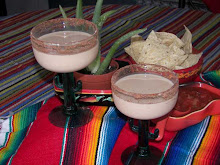
Chocolate Margaritas
(makes 2 servings)

Chocolate-Chile Powder*, for rims of glass
1 shot chocolate liqueur
1 shot chocolate vodka (Van Gogh’s)
1 shot tequila
1 shot coffee flavor liqueur
1 shot half and half (optional)
Chocolate-Chile Powder*
2 tablespoons Mexican Chocolate ground into powder
1 tablespoon ground red chile powder

Mix Chocolate Chile Powder ingredients completely and spread out over an open dish. Moisten rims of margarita glasses and dip into the Chocolate-Chile Powder.

For margaritas:
Fill a shaker with ice. Add margarita ingredients. Shake for about a minute. Pour into garnished margarita glasses.
(c)2008

Monday, June 9, 2008

Biscochos


Biscochos, or Polvorones as my grandmother called them, are tiny little cookies that are almost always found in Hispanic gatherings: weddings, birthdays, Christmas, most celebrations.

Traditionally, they are cut into small diamond shapes, but you can certainly use any small, non-intricate, cookie cutter to give them shape. Some even use a shot glass to cut small rounds out of the dough.

Their texture is that of the richest, flakiest piecrust you’ve ever tasted and enjoyed. They are slightly sweet with a hint of cinnamon and are very crumbly, like powder – polvo, thus the name “Polvorones”.

Different bakers of this delicious confection have been known to flavor their biscochos in their own way. Some use a little wine or a little brandy; some use anise while others use cinnamon; some will use eggs and some will use shortening instead of lard. All results are delicious regardless of the added ingredients.

But, there is still only one original recipe. With this basic recipe, you can incorporate whatever ingredients you might want to use to make it your own specialty. My grandmother used a little wine instead of milk for wedding biscochos and she always used lard.

I was taught how to make them using coffee cups and soups spoons for measurements and have since had to interpret the amounts for the cookbook. Here is my Grandmothers recipe. Use it and make it your own.

However you decide to prepare your biscochos, know that you are engaging in a true Mexican (and Mexican-American) tradition. These little cookies are part of our culture.

Remember that no recipe is set in stone. They are simply guidelines for you to follow and create your own unique dishes.
(c)2008

Polvorones (Biscochos)

2 lbs. (about 6 1/2 to 7 cups) flour
2 tbs. baking powder
2 tbs. sugar
2 tsp. cinnamon
1 lb. lard
½ cup warm milk

Cinnamon-Sugar Coating
2 tsp. cinnamon
1-cup sugar
Preheat oven to 350 degrees

Combine flour, baking powder, sugar, and cinnamon in large mixing bowl. Whisk to combine.

Cut the lard into the flour mixture with a pastry blender, or use your hands by gently rubbing the lard and flour together until you reach the consistency of coarse meal.

Add warm milk and gently mix until well blended. DO NOT over mix the dough. It toughens the pastry.

Roll out a small portion of the dough between two pieces of waxed paper. Remove the top layer of paper and cut out the cookies. Gently lift cookies with a lightly floured spatula and place on ungreased cookie sheets.

Bake for 10 minutes. Allow cookies to cool on rack for 6 to 8 minutes then coat in cinnamon sugar coating.

Makes 5 to 6 dozen small Polvorones.
(c)2008

Tuesday, June 3, 2008

The Two Fisted Food Writer

There’s no doubt about it, I love cooking and eating. But I also love to read and write about food.

I keep my laptop in the dining room where I can be close to the kitchen. As I test or develop recipes, I usually go straight to the computer and make my notes. I also keep several composition books (the kind you can buy 2 for $1.00) on the table and a stack of sharpened #2 lead pencils close by just incase the computer goes down. There will be times when I’m cooking in the kitchen with a pencil in my mouth, or leaning over my laptop trying to input some notes one-handed because I’ve got a wooden spoon or potholder in the other.

For me, the two go hand-in-hand. Working on the Mexican American border food website I once had for seven years and the ensuing cookbook that developed from the website, I had to learn how to multitask. Developing, cooking, testing (and tasting), designing, inputting, photographing, uploading, downloading, looking up html codes, promoting, and praying. I guess it would have helped if I’d had the appendages of an octopus. Eight hands are better than two.

Don’t get me wrong. I’m not complaining; I loved it. Help from my family was always available but I tend to be OCD about my work and my passion. Looking back, perhaps I should have been more appreciative for the help instead of insisting that the tasks at hand be followed in a certain progessional line. Since those busy days in my life, I think I’ve learned to chill out a little and be more adventurous and think outside the box.

Having a successful food website and publishing a cookbook was an incredible feat. One that I believe would never have been accomplished if it hadn’t been for the invaluable assistance, through manual labor and moral support, from my husband and children (my daughter-in-law included).

So, if you’re thinking of starting your own website or wanting to publish a cookbook, go slowly. Begin with a homemade cookbook for your kids or maybe start a blog about cooking. And for Pete’s sake, never, never turn down any help you can get. Take it from someone who has Fibromyalgia and arthritis. The more hands you’ve got helping with the slicing and dicing, designing and inputting, the happier you’ll be. You can always go back and change what needs correcting. Because YOU are the head chef, and even Emeril has a staff.

Now, it’s time for a break. Let’s make a cup of Mexican Java and sit back and relax before you get up and start cooking again.

Mexican Coffee
(Makes 4 to 6 servings, depending on the size of cup)

½ cup ground coffee
1 (3-inch) cinnamon stick broken in half
1 small (about 3-ounce) piloncillo (Mexican brown sugar but with a lot more molasses in it) cone, or
4 tablespoons firmly packed brown sugar

Place the coffee in a filter container of a drip-style pot. Scatter the cinnamon and brown sugar over the coffee. Brew with 4 cups of water.

If it’s evening or you just want a little zip in your coffee, add a half-ounce of Kahlua to each cup and maybe top off with a little whipped cream and some grated chocolate on top. ENJOY.