Saturday, December 27, 2008

MENUDO - The El Paso Way to Cure a Hangover

Menudo is one of those dishes you either love or hate. Just like cilantro. For those of you that don't know what the key ingredient in this dish is, prepare yourself...it's tripe. What is tripe you ask? Well, by definition it is the lining of the stomach of a cow, but sometimes of a pig or sheep.

Menudo is an incredibly popular stew here in the southwest, especially if you grew up with it. Having menudo on the weekends, especially after a pachanga (party) was a given. Coming back after partying in Juarez in the days when you could go to Juarez without fearing for your life (1500 murders in Juarez , drug cartel wars, and the year isn't over yet!!!), it was always customary to stop at the Good Luck Cafe on Alameda street to have a huge bowl of menudo, some bolillos, and several cups of coffee. No-fail way to keep from getting a hangover or get rid of one.

Anyway, since I was reminiscing about my past, I couldn't leave out one of the staples that was on our table every Sunday. My brother Mando makes the best menudo anyone has ever tasted. Bob and Lily won't eat it, but my son Michael will. It's an acquired taste, unless you grew up on it. I hope you try it and enjoy it. It's made with tripe, posole (hominy), red chile and some people even cook it with pigs feet! Gives it an incredible flavor. Aprovecho!
Menudo

3 ½ pounds beef tripe, rinsed well and cut into 1 inch squares
3 to 3 ½ pounds beef shanks or pigs feet
10 cups water
2 medium sized onions, chopped
10 cloves garlic, minced or pressed
2 teaspoons ground cumin
Chile Purée (recipe follows)
3 large cans (29 ounces each) white or yellow hominy, drained
Salt
Garnishes (see suggestions below)

In an 8 to 10 quart pan, combine tripe, beef shanks, water, onions, garlic, and cumin. Bring to a boil over high heat; reduce heat, cover, and simmer until tripe is very tender ( 6 to 7 hours ). Meanwhile, prepare Chile Purée, set aside.
Skim and discard fat from liquid. Lift beef shanks from pan; discard bones and fat. Cut meat into chunks and return to pan with purée and hominy. Season to taste with salt. Bring to a boil; reduce heat, cover, and simmer for 30 minutes. If made ahead, cool, cover, and refrigerate for up to 2 days; reheat before serving.
Pour soup into bowls; offer garnishes to add to individual servings. Makes 10 to 12 servings.

Chile Purée

Discard stems and seeds from 9 large dried red chiles (either New Mexico or California) in a bowl with 3-¼ cups warm water. Let stand until softened (20 to 30 minutes). Discard all but 1-¼ cups of the liquid. In a blender or food processor, purée chiles with liquid until smooth, scraping sides of container once or twice.

Garnishes
Choose from the following, arranged in separate bowls: 3 limes or lemons, cut into wedges; ½ cup fresh oregano leaves; 1 cup fresh cilantro sprigs; 1 medium sized onion, chopped; and ¼ cup crushed dried hot red chiles or 5 fresh Serrano or jalapeño chiles, stemmed, seeded, and thinly sliced.

If you don't care for the tripe in Menudo, try this recipe with the pozole and pork.

Pozole Stew

2 packages (¾ pound each) dried pozole or fresh frozen pozole
10 ounces pork shoulder, trimmed of fat and cut into 1 inch cubes
2 cups Green Chile Sauce, recipe follows
6 cloves garlic, minced
1 white onion, finely diced
4 dried red New Mexico chiles, rinsed, stemmed, seeded, and coarsely chopped
2 tablespoons chile powder
2 teaspoons ground cumin
1 tablespoon dried oregano leaves
1 tablespoon red pepper flakes
2 teaspoons salt
6 quarts water

If using fresh-frozen pozole, rinse it well under cold running water. Place all of the ingredients in a large pot and bring to a boil. Reduce the heat to low and simmer, uncovered, stirring occasionally, until the kernels have opened up and are tender, 2 ½ to 5 hours, depending upon the type of pozole you are using.Add water as needed to keep the pozole just covered with liquid. When the stew is ready, the consistency should be that of a thick soup.Adjust to taste with more garlic, dried red chile, and salt before serving. Serves 8.

Green Chile Sauce

1 can ( 8 ounce ) tomato sauce
1 can ( 4 ounce ) chopped green chile
½ medium onion, chopped
1 clove garlic, minced
½ teaspoon crushed red pepper
Dash of salt
Pinch of oregano

Mix all ingredients and store in refrigerator. Good also with tacos, tostadas, huevos rancheros, and as a dip. For extra spiciness, add one minced jalapeño. Makes 1 cup.

Christmas in the Barrio

(I wrote this piece many years ago. I wanted to share it with you today. I didn't post before today because my mind was filled with all sorts of memories. My Dad, died homeless and an alcoholic on a Christmas day when I was only 5. My mother passed away eleven years ago. This is the first Christmas without our son here in town and the first Christmas our precious daughter shares her time with her own true love.
The older I get the longer it takes me to adjust to change and to view the past as a stepping stone to the present. We've all been there, this is nothing knew. I just wanted to give you a peak into who I am and why I have found it a tad difficult to post lately. May you continue to have a glorious holiday with your loved ones. Besos y abrazos.)

When Charlie, from segundobarrio.com, asked me to write an article about memories of a "Mexican Christmas" in the barrio, it started me thinking about what I actually enjoyed about the holiday as a Hispanic. My husband has always called me the Queen of Holidays, but over the course of the last few years I realized that Christmas had lost a lot of the meaning it held for me as a child growing up in the Segundo Barrio. So, this has given me an opportunity to examine where it had all changed.

As an after thought, if I were my daughter I'd be going "duh!" to myself. What was lost, but in reality just hidden deep down inside of me, was the emphasis of love and caring that we held for each other at a most glorious time of the year. These warm fuzzy feelings had been replaced with shopping, and money, and putting up more lights than our neighbors had last year ("We'll worry about the electric bill later, honey."), and "Is the tree big enough? It's by the window and everyone can see it. What'll they say if it's too small?"

The Christmas season for my brothers and me always started with the celebration of Our Lady of Guadalupe. (Unlike today where it starts with Hobby Lobby putting up Christmas displays in September.) San Ignacio Church would overflow with poinsettias and roses for our Lady. We knew once we saw Mom scotch-taping her little string of lights around her picture of the Virgen de Guadalupe (one taken out of a magazine and set in an old picture frame she had) that the holidays were near. Las Posadas would be right around the corner and that meant 9 evenings of going to San Ignacio Church to attend mass and the Posadas processions around the church's courtyard. There would be a piñata after the procession and a small, brown, paper lunch bag filled with an orange, an apple, peanuts, and maybe a few brightly colored, sweet, hard candies. How happy we were.

Then, it would be time for a Christmas tree and a couple of gifts for each of my brothers and me. I remember one particular Christmas when I was about eight or nine. Mom, being a widow, didn't quite have enough to buy a Christmas tree. She worked for the El Paso Public School system (as a head cook I'm proud to say) and she'd usually be given the tree that was put up in the school cafeteria for the students. Well, this one year, expecting the same, she hurried up with her work and went into the auditorium and the tree was gone. Someone else had already taken it. She was devastated. Growing up in the Alamito Projects meant there was never enough money to go around, so putting up a tree was always one of the more exciting moments of the holidays. She came home in tears. The days went by and my brothers and I didn't dare ask her what was going on, "Where's the tree?". Christmas Eve, one of my brothers took me by the hand and told my Mom we'd be back soon. He walked us over to Stanton Street and it felt like we had been going around and around in circles forever. Finally, we stopped at an almost deserted tree stand. My brother asked me to wait by the curbside and sauntered over to speak to a man who was obviously getting ready to close down the stand and go home to his own family. Before I knew what was happening, my brother came walking back with an incredibly huge smile on his face and the scrawniest, most lopsided, yet most beautiful tree I'd ever seen. It was a tree that would have been thrown out because no one wanted it, but it turned out to be our Christmas gift to Mom. When I remember this kind "tree-stand" man, I ask God to bless him for his generosity.

Another thing that I found missing from my childhood Christmases was Tia Cata, short for Catalina, coming in from Chihuahua to visit my grandmother Annie. She would come into town for a few days before the holiday and go shopping at Kress' department store. You could buy a bunch of really cool stuff there. Shiny, big, inexpensive things that looked great under the tree. But the best part of Tia's visit was the making of the tamales for the family. She would get up bright and early on the 23rd and start cooking the pork roast. The aromas in my grandmothers' house were amazing. See, while Tia Cata made tamales, my grandmother would be making "polvorones", known by some people as biscochos. My brothers and I would dream up every possible excuse to visit my grandmother during the day. This meant getting tamales fresh out of the steamer and polvorones so warm the cinnamon-sugar coating was dissolving as we popped them into our mouths.

These wonderful memories have helped me to see Christmas a little differently now than I did during those years of trying to get ahead and build a career. I've made a silent promise to my children that they too will have a most glorious Christmas, like the ones I had. Filled with singing and laughing, making tamales and polvorones, going and taking a poinsettia plant to La Virgen de Guadalupe on her day, experiencing Las Posadas and knowing it's true meaning. Then, on Christmas Eve, my husband and I can sit by our "little tree" having a "calientito" (hot toddy) and feel grateful that we are part of a culture that can remember how the true meaning of Christmas was and always should be celebrated. Thank you for letting me share these thoughts and feelings with you. May God bless everyone this holiday season. Feliz Navidad y un Prospero Año Nuevo.

Su amiga siempre, Tere.

Monday, December 15, 2008

Mexican Holiday Traditions

Legend of the Poinsettia

The legends states that there was once a young Mexican girl named Pepita who was very poor and had no gift to offer the Christ Child at Christmas Eve services. She was terribly sad as she walked to the chapel in her village.

Not knowing what else to do, she bent down by the roadside and picked some flowering weeds to take as an offering to the Nativity.

As she sauntered up to the altar, she remembered the kind words her little friend Pedro had told her, "Even the most humblest of gifts, if given in love, are acceptable in His eyes". She felt her spirits lift a little.

As she lay the bouquet of weeds down, they burst into a brilliant bloom of red. Everyone at the chapel was certain they had witnessed a Christmas miracle.

From that day on, the bright flowers were known as the "Flores de Nochebuena", the Flowers of Christmas Eve, for now they bloom each year during the Christmas season.


Las Posadas

A colorful and enjoyable Christmas tradition in the Hispanic culture: "Las Posadas". This celebration takes place from December 16th to December 24th, Christmas Eve. It is the re-enactment of the journey from Nazareth to Bethlehem endured by Joseph and Mary while seeking shelter before the Christ Child was born. Posada, in Spanish, means lodging. In each one of these nights, two children, a boy and a girl, pose as Mary and Joseph. Other children act as angels and shepherds. Candles are held by each and everyone to light the way. Meanwhile parents and neighbors walk behind them as the multitude, singing and saying prayers. If the Posada is acted out in a neighborhood, a stop is made in several homes, where Mary and Joseph ask for shelter and they are turned down. At the last stop, they are welcomed, and the party begins. A piñata is provided for the children while special seasonal foods are laid out for all to enjoy. The feast usually includes tamales, capirotada, champurrado, buñuelos, and hot Mexican chocolate. Look for these recipes in the index and create your own Las Posadas Feast.

Champurrado

½ cup fresh masa (corn dough) or 1/2-cup masa flour (masa harina) mixed with a 1/4-cup hot water to blend
2 1/4 cups milk
1 1/2 cups water
1 disk Mexican Chocolate, chopped
3 tablespoons piloncillo, chopped or 1/3-cup brown sugar plus 2
teaspoons molasses
Cinnamon stick (optional)
1/4 teaspoon crushed anise seeds (optional)

Place the water and the masa into the jar of a blender and blend until smooth. Transfer to a medium sized saucepan. Add the milk, chocolate, piloncillo (or sugar, molasses combination) and the anise seeds if you wish to use them. Bring the mixture to a simmer, whisking with a molinillo or whisk until the chocolate and sugar is melted and well blended. Strain the mixture through a medium sieve (optional) and serve hot, in mugs.

Capirotada (de Chocolate)

8 slices of pound cake, cubed
3 eggs, beaten
1/3-cup milk
1-teaspoon cinnamon
2 tablespoons brown sugar
1 cup chopped pecans
1 cup dried cherries or raisins
1 medium granny smith apple
1 cup Jack cheese, shredded
Chocolate Sauce*

Preheat oven to 350°. Butter a glass-baking dish.

Place half the pound cake cubes into the baking dish.

Mix eggs, milk, cinnamon and brown sugar and pour half of this mixture over the top of the cake cubes in dish.

Sprinkle half pecans, cherries or raisins, apple, and cheese on top.

Add another layer of pound cake cubes followed by the egg mixture and remaining ingredients. Top with chocolate sauce.

Bake 25 minutes or until cheese has melted. Serve with remaining chocolate sauce if desired.

*Chocolate Sauce:

1 cup half and half
1 stick cinnamon
½ disk Mexican Chocolate, chopped

Combine half and half and cinnamon stick in medium sauce pan and heat to scalding. Lower heat and add chocolate. Whisk until chocolate melts and remove from heat. Remove cinnamon stick before using.

Traditional Capirotada (Bread Pudding)

8 slices bread, toasted
3 eggs, beaten
5 tablespoons milk
1 teaspoon cinnamon
2 tablespoons brown sugar
½ cup toasted, slivered almonds
½ cup unsalted peanuts
½ cup walnuts, chopped
½ cup raisins
1 medium apple, pared, cored, and thinly sliced
1 cup Jack cheese, cut into small cubes

Preheat oven to 350º. Butter a square-baking dish.Place four bread slices in pan. Mix eggs, milk, cinnamon, and brown sugar. Pour half of milk, eggs, and sugar mixture on top. Sprinkle with half of remaining ingredients. Add another layer of bread and repeat as above. Top Capirotada with *Panocha Syrup and bake 25 minutes or until cheese is melted. Serve warm or reheat, covered, for 15 minutes. Makes 8 to 10 servings.

*Panocha Syrup:
2 cups brown sugar
2 cups water
1 cinnamon stick

Combine ingredients in a medium size saucepan. Bring syrup to a boil. Lower heat and simmer approximately 15 minutes until syrup is slightly thickened. Remove cinnamon stick.

Saturday, December 13, 2008

Christmas Dinner - Texas Style

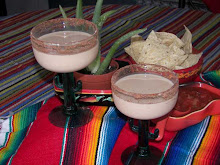
Christmas dinner, very much like Thanksgiving dinner, is a simple one. After a meal of tamales, Mexican hot chocolate and Polvorones (biscochos) on Christmas Eve, we take pleasure in feasting on a Texas style dish of Brisket with red chile- BBQ sauce and Borracho beans. An easy appetizer of guacamole, pico de gallo and sour cream topped with homemade tortilla chips is served in large margarita glasses so that you can take it with you from room to room and never stop munching while you’re waiting for the brisket to be done. It turns into a lovely day sitting around with our daughter and her better half while Bob blares Christmas music through the stereo and tunes into the football game with the sound turned down.

The phone rings constantly with calls from family members, this year including our son Michael and our daughter in law Jennifer. This is the very first time without my son with us for the holidays and I’m feeling a little sad. But he’s been calling and asking for confirmation on the ingredients for making tamales. Seems it’s a little difficult to find the ingredients they need in Dallas where they live. But they’ll manage. Those two are quite resourceful.

So, if you have a “hankering” for a Texas style Christmas, try our simple menu and enjoy. Love you guys.

Borracho Beans

1 pound pinto beans
1 medium onion, diced
5 to 6 cups water
3 fresh tomatoes
4 green chiles, diced
2 cloves garlic, minced
1 can beer
Salt to taste
sliced pickled jalapeños, optional

Wash and sort pinto beans. Add onion and water to beans and bring to boiling point. Remove from heat and cover for two hours. Peel tomatoes and chop into small chunks. Add tomatoes, chiles, garlic and beer to beans, bring to second boil. Reduce heat and simmer from 5 to 6 hours. Add salt half an hour before serving. Makes 6 to 8 servings.

Brisket with Red Chile BBQ Sauce

1 (4 pound) brisket
1 bottle of your favorite barbecue sauce
1 (14 ounce) can beef broth
1 cup red chile* sauce

Preheat oven to 200 degrees.Lay brisket over a long piece of heavy duty aluminum foil. Brush completely with your favorite barbecue sauce. Wrap the brisket in the aluminum foil. Make sure it is wrapped tightly. Place on rack on a deep baking dish. Pour water to 2 inches in baking dish. Roast brisket for 8 hours until tender.

Thirty minutes before the brisket s done, combine the beef broth, 1 cup red chile sauce, and 1/2 cup barbecue sauce in saucepan. Whisk until well combined. Continue heating over low heat until ready to serve.When brisket is done roasting, remove from oven and allow to rest on counter while still wrapped in foil.Right before serving, slice brisket against the grain in thin slices. Serve with red chile BBQ sauce.*

Red Chile Sauce
9- (about 3 ounces) dried New Mexico or California red chiles, hot or mild or a combination of both
2- cups water, or more, to cover chiles completely with water in pan
1- small onion, chopped
2- cloves garlic, chopped

Toast chiles on a large baking pan for approximately 4 minutes. Let cool slightly and then remove seeds and stems.

IMPORTANT! Wear rubber gloves when handling chiles. If you accidentally rub your eyes when handling chiles without gloves, it will really sting.

In a 4-quart pan, combine chiles, water, onion, and garlic. Cover and bring to a boil over high heat. Reduce heat and simmer (covered) until chiles are soft (about 30 minutes). Remove from heat and cool slightly. In blender, whirl chile mixture till smooth. Run through sieve (strainer) to discard residue and any unprocessed chile skins. Purée can be refrigerated (covered) up to 1 week. Makes 2 cups.

* If you want a hotter tasting chile sauce, try adding 1 or 2 "chile de arbol", stemmed and seeded, to the chile in the water simmering step.

Friday, December 5, 2008

La Virgen de Guadalupe


The Virgen de Guadalupe appeared to Juan Diego, an Aztec Indian converted to Christianity, in December of 1531. She proclaimed to be the mother of God. Juan Diego first beheld the Madonna on Tepeyac Hill; right outside of what is now know as Mexico City. She appeared to him with dark skin and Indian-like facial features. As the legend goes, after several attempts by Juan Diego, at the Virgen's instruction, to persuade the local bishop to have a temple built on the Tepeyac site, she told Juan Diego to gather the flowers (roses) growing on the hill and to bundle them up in his tilma, cloak. She told him to give these to the bishop as a sign and proof of her existence. When Juan Diego did as the Virgen had asked of him, he opened his tilma and there appeared the image of the Virgen de Guadalupe.To this day, the tilma is displayed in the basilica in Mexico City. The proof of the miracle remains steady as the tilma, despite its age, has not shown signs of deterioration and the image of the Virgen is just as crystal clear as the day Juan Diego presented the Virgen's roses to the bishop.

December 12th is the Virgen de Guadalupe’s feast day. Mariachis will play at her mass and matachines will dance in the courtyard. This a most glorious festival for Catholics and especially Hispanic Catholics in Mexico and all along the Southwestern Border.

After four and a half centuries, Juan Diego has now been canonized as a Saint in his own right.


There are so many depictions of the Virgen de Guadalupe; I don't even know where to begin. The picture you see to the left is a plaque that once belonged to my mother. I bought it for her to replace the copy she had taken out of an old magazine and had framed in a dime store metal frame. That memory will stay with me for a long time. Once my mother started taping a small string of lights around the image of the Virgen, we knew the Christmas Holiday season was near. The Virgen's image is found everywhere, murals, clothing, expensive paintings, on motorcycles, on the clothing worn by Matachines (Mexican Indian dancers), on book covers, you name it. MexGrocer has posters of the Virgen for sale online, click here to get to the site.

There is also a novena that can be recited and offered to our beautiful Lady of Guadalupe, click here.

Legend of Juan Diego


Juan Diego, born in 1474, was an Aztec tribesman who had converted to Christianity. He was a meek and humble man; married to Maria Lucia, who had also been baptized in the Christian faith. Juan Diego was known to be a deeply devoted and religious man. He walked 14 miles from his village of Cuauhtitlan to Tenochtitlan (now Mexico City) to receive instruction on religious doctrine.

In 1529, Maria Lucia died and Juan Diego moved to Tolpetlac, which was 9 miles closer to Tenochtitlan.

Every weekend he walked, barefooted, the 9 miles to hear mass. (Only the higher social classes wore sandals.) To keep warm on the long chilly walks to church, he wore a mantle, tilma, made with the fibers of the maguey cactus. (Only upper Aztec classes used Cotton.)

One day during his long trek to the church as he approached the foot of Tepeyac Hill, he heard music and a voice calling to him, "Juanito, Juan Diegito, the most humblest of my sons...". Juan Diego, startled, but drawn to the voice, went up the rocky hill. As he looked up, he found himself face to face with a beautiful Lady. Her garments shone brightly with the early morning rays of the sun. She looked to be young. She beckoned him and as he approached, he fell to his knees in veneration.

She asked him where he was going and he told her he was on his way to mass. She smiled and told him that She was the Virgin Mary, Mother of the True God. She asked him to tell the Bishop that it was her desire that a temple be built at the very spot where she stood.

Juan Diego immediately went to the city and relayed the message to the Bishop. The Bishop listened politely and soon dismissed him. Juan Diego returned to Tepeyac Hill and told the Virgin. She once again very kindly instructed him to return and tell the Bishop of her wishes. When Juan Diego once again returned to the Bishop, the Bishop told Juan Diego that he would need a sign from Heaven for his story to be more convincing.

When Juan Diego returned to the Lady and explained to her what the Bishop wanted, She smiled tenderly at him. On the morning of December 12, she asked him to go gather flowers growing at the top of the hill. She told him to take them to the Bishop as the sign that the Bishop had requested.

When Juan Diego returned to the Bishop, he opened the tilma to uncover the flowers that the Virgin had told him to deliver to the Bishop. For the longest moment, everyone's eyes were on Juan Diego and his tilma. As the flowers dropped from his mantle, a replica had appeared on the cactus cloth, an exact replica of the Virgin herself as she had first appeared to Juan Diego at Mount Tepeyac.

The tilma, despite its age of over four hundred years, still exists and is at the Old Basilica of Guadalupe in Mexico City.

Wednesday, December 3, 2008

Galletas de Mantequilla / Butter Cookies

My mom made the best butter cookies in the world. She use to make them when she was a cook for the El Paso Independent School system. The kids would devour them, but of course she always managed to bring a couple home for us. I still have her original notes and recipe well guarded. It's a simple recipe, only four ingredients. And it's so versatile I can't begin to describe all the ways my kids and I have made this recipe: the shapes, the colors and the flavors. For the holiday season, I would like to share with you this wonderful recipe. Your children will be able to make them easily with little help from you. Enjoy and know that's it's from the heart.

Galletas de Mantequilla
(Butter Cookies)

1 cup (2 sticks) softened butter
½ cup sugar
1-teaspoon vanilla
2 to 2½ cups flour

Cream butter and sugar together. Add vanilla. Slowly, add flour and knead to combine well. Chill dough in refrigerator for 30 minutes for easier handling. Roll out a small portion of the dough between two pieces of wax paper to ¼ inch thickness. Dip cookie cutter in flour and cut out desired shapes. Bake on an ungreased cookie sheet for 10 to 12 minutes (middle of oven) at 325°. If desired, before chilling dough, add food coloring during the mixing process. Also, after cutting with cookie cutters, you may sprinkle shapes with colored decorating sugars. Makes about 1 ½ to 2 dozen, depending on size of shapes cut.

Butter Cookie Pecan Sandies
(makes about 3 dozen)

Prepare the Butter Cookie dough and add 1 cup chopped pecans. Roll into a log and refrigerate for 40 minutes. Slice into 1/4 inch rounds and bake for 10 to 12 minutes. Allow to cool 5 minutes and dust with confectioner’s sugar.

Thumb Print Cookies
(makes about 3 dozen)

With this recipe, you make roll 1 inch balls (after the dough has been in the refrigerator of 40 minutes). Have a cup of finely chopped pecans. Roll half of the 1-inch alls in the pecans, the others leave as is. Using your thumb, press an indentation in the middle of each cookie before baking in the oven. When you remove the cookies, allow to cool for a couple of minutes and then with a spoon, top each indentation of each cookie with jam or preserves. We used raspberry, cherry and apricot. Actually, we got carried away and even topped some of the cookies with a Hershey kiss.

Snowball Surprise
(makes about 3 dozen)

Here we took the same recipe but added 1/4 cup of cocoa. Allow the dough to rest in fridge for 40 minutes. Take a scant amount of the dough and flatten in your hand. Place an unwrapped piece of chocolate (like a Hershey kiss) and place in the middle of the dough. Wrap the chocolate piece with the dough and roll around in the palms of your hands to form a ball. Bake for 10 to 12 minutes. Remove from oven and allow to cool for 5 minutes. Dust with confectioner’s sugar.

Then of course, there are the regular cookie cutouts. You can tint the dough with food coloring or use colored sugar sprinkles for the top. You can frost the baked cookies with homemade buttercream frosting. Use your imagination. Better yet, let the kids come up with their own unique cookie for the holiday.
*****************************
Be sure and check out
The Chocolate Shop
for last minute online shopping.